
RMS Selection Process Explained: Written Test, Interview & Medical — What Really Happens
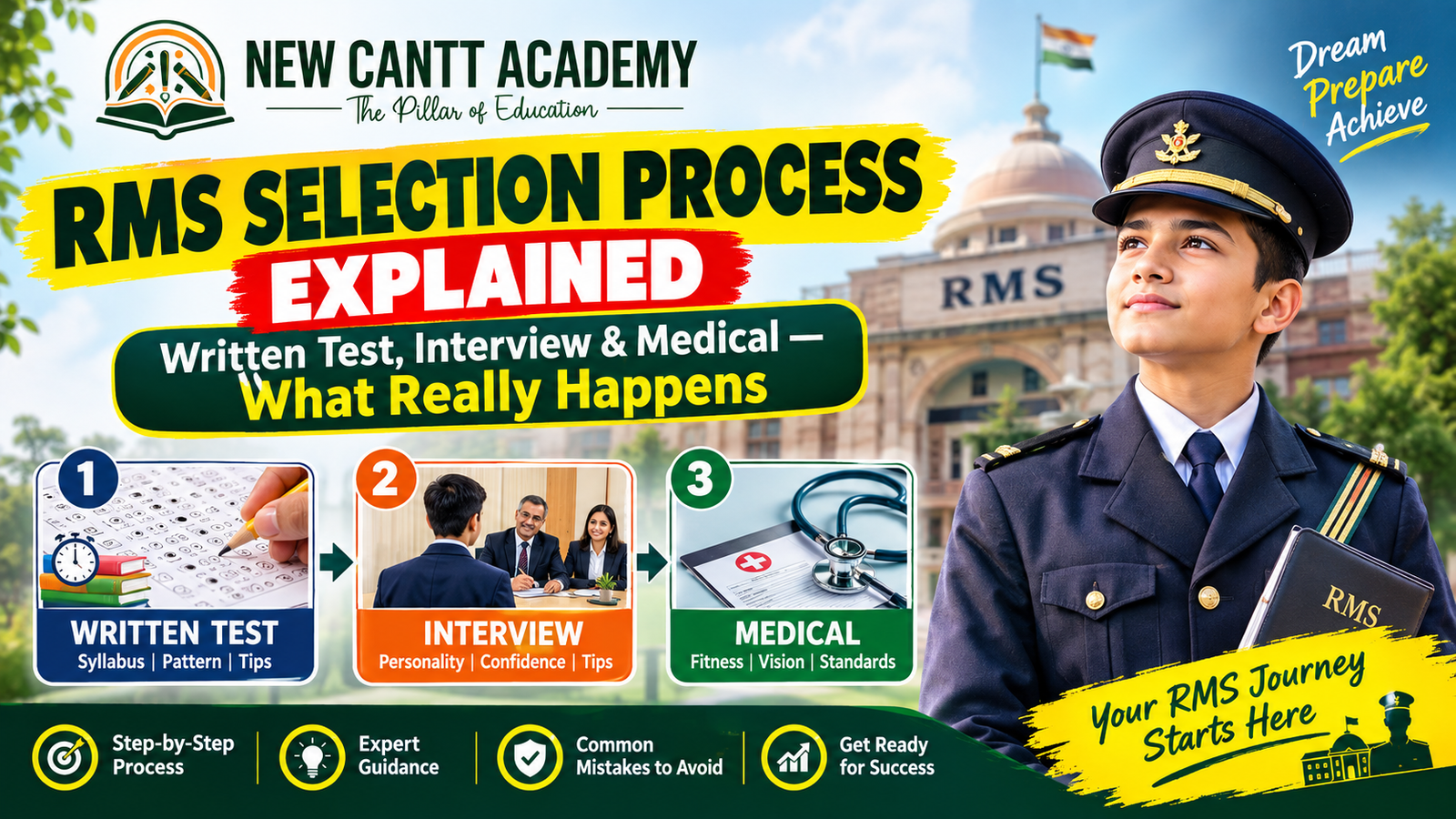
When parents hear that their child has cleared the Common Entrance Test (CET) for Rashtriya Military School (RMS) admission, they often celebrate prematurely. But here’s what most don’t realize: the RMS Selection Process Explained reveals that passing the written exam is just the beginning.
The RMS Selection Process Explained through a three-stage filtration system that goes far beyond multiple-choice questions. Over 5,000+ aspirants apply annually for fewer than 500 seats across various RMS centers in India. The competition is fierce, and each stage serves a critical purpose—not just in selection, but in identifying candidates who possess the right temperament, communication skills, and physical fitness for military school life.
At New Cantt Academy, we’ve guided hundreds of students through this multi-stage selection journey. In this detailed guide, we break down exactly what happens at each stage, what evaluators look for, and most importantly—how to prepare strategically for all three stages simultaneously rather than treating them as isolated hurdles.
Key Insight: Only 8-12% of CET qualifiers make it past the interview and medical stages. Understanding the RMS Selection Process Explained helps you be part of this elite group.
Overview: The Three Stages of RMS Selection
The RMS Selection Process Explained consists of three sequential stages, each with specific weightage and elimination criteria:
| Stage | Component | Class VI | Class IX | Purpose |
|---|---|---|---|---|
| Stage 1 | Written Test (CET) | 120 marks | 140 marks | Academic foundation & knowledge assessment |
| Stage 2 | Interview | 20 marks | 50 marks | Personality, confidence, awareness evaluation |
| Stage 3 | Medical Exam | Qualifying only | Qualifying only | Physical fitness & health certification |
The Selection Funnel:
- CET filters roughly 30-40% of applicants
- Interview eliminates another 60-70% of CET qualifiers
- Medical acts as the final qualifier (rarely eliminates but confirms fitness)
Understanding this RMS Selection Process Explained structure is crucial because it shows that interview preparation is NOT optional—it carries significant weightage, especially for Class IX candidates.
Stage 1: The Common Entrance Test (CET)
Subjects and Marks Distribution
The first step in the RMS Selection Process Explained is the CET, which varies by admission class:
Class VI CET:
- English: 40 marks
- Mathematics: 40 marks
- General Knowledge: 40 marks
- Total: 120 marks
Class IX CET:
- English: 40 marks
- Mathematics: 50 marks
- Science: 25 marks
- Social Studies: 25 marks
- Total: 140 marks
Qualifying vs. Merit Marks — The Difference Most Parents Miss
This is where the RMS Selection Process Explained becomes tricky. There are two separate benchmarks:
- Qualifying Marks: Approximately 40-45% of total marks. Your child must score this minimum to proceed to the interview stage.
- Merit Marks: The actual score used for final merit list preparation. A student might score 65 marks out of 120 in CET, qualifying them for the interview, but this same 65-mark score will be used in the final calculation.
Example: If your child scores 60/120 in CET and qualifies for interview with 18/20 marks, the final score would be calculated as 60 + 18 = 78 (depending on the weightage formula).
How CET Performance Decides Interview Call-Up
Typically, 1.5 to 2 times the number of available seats are called for interview. If there are 100 Class VI seats available, approximately 150-200 CET qualifiers get interview calls. This means:
- Scoring above 50 marks in CET almost guarantees an interview call
- Interview performance then becomes decisive for final selection
- The RMS Selection Process Explained at this stage means that both CET and interview scores matter equally or interview carries higher weightage
Pro Tip: Focus on scoring 60+ in CET. This comfortable margin ensures you’re not competing at the borderline during interview rounds.
Stage 2: The Interview Round
What the Panel Actually Evaluates (Not Just General Knowledge)
This is where the RMS Selection Process Explained becomes most misunderstood. Parents often assume interviews test only GK, but military schools evaluate much more:
Interview Evaluation Criteria:
| Parameter | What Evaluators Look For | Weightage |
|---|---|---|
| Communication | Clarity, confidence, listening skills | 25% |
| Awareness | Current affairs, school knowledge, purpose | 25% |
| Personality | Leadership traits, discipline, conduct | 30% |
| General Knowledge | Facts, historical awareness, geography | 20% |
Interview Marks Weightage: Class VI (20 marks) vs. Class IX (50 marks)
For Class VI: Interview carries only 20 marks (approximately 14% of total selection score) For Class IX: Interview carries 50 marks (approximately 26% of total selection score)
This explains why Class IX candidates need stronger interview preparation. A brilliant interview performance can make a 15-20 mark difference in final selection.
Common Questions and Assessment Approach
Standard Interview Questions in RMS Selection Process Explained:
- “Tell us about yourself” — They’re evaluating articulation and self-awareness
- “Why do you want to join RMS?” — Assessing motivation and knowledge about the institution
- “Describe your school and achievements” — Checking confidence and communication
- “What do you know about the Armed Forces?” — Testing awareness and interest
- “What’s your greatest strength and weakness?” — Evaluating self-reflection
- “Current affairs questions” — Assessing awareness and general knowledge
Assessment Approach: The panel consists typically of 3-4 senior officials. They’re not looking for rehearsed answers but for natural confidence, genuine interest, and the candidate’s ability to think on their feet.
Stage 3: The Medical Examination
What the Medical Test Checks and Disqualification Factors
The final stage of the RMS Selection Process Explained is the medical examination. While it’s technically “qualifying only,” failing here means elimination:
Medical Fitness Assessment Includes:
- General Examination: Height, weight, BMI assessment
- Cardiovascular: Blood pressure, pulse rate, heart examination
- Respiratory: Chest examination, breathing capacity tests
- Ophthalmology: Vision testing (corrected vision acceptable up to -4 to +4 diopters)
- Dentistry: Dental health assessment
- Orthopedics: Bone and joint examination, mobility assessment
- ENT: Ear, nose, throat examination
- Psychology: Basic aptitude assessment and temperament evaluation
Common Disqualification Factors:
- Serious medical conditions (heart disease, asthma requiring continuous medication)
- Hearing impairment beyond permissible limits
- Dental issues that affect mastication
- Orthopedic problems limiting physical activity
- Color blindness (varies by service preference)
Documents and Certificates Required
Understanding the RMS Selection Process Explained includes knowing documentation requirements:
- Birth certificate or Aadhar
- Transfer certificate from previous school
- Character certificate
- Medical history details
- Vaccination records
- Parent/Guardian ID proof
Timeline: When Medical Happens Relative to Selection List
Typically, medical examination happens after interview success but before final selection list publication. Some schools conduct medical examinations simultaneously for top-ranked candidates to save time.
How Final Selection Is Decided
Combining CET + Interview Scores — Merit List Calculation
The RMS Selection Process Explained culminates in a weighted scoring system:
Typical Weightage Formula:
| Component | Class VI | Class IX |
|---|---|---|
| CET Score (out of 120/140) | 70% | 60% |
| Interview Score (out of 20/50) | 30% | 40% |
| Medical Examination | Qualifying | Qualifying |
Example Calculation (Class IX):
- CET Score: 105/140 = 75%
- Interview Score: 38/50 = 76%
- Final Score: (75 × 0.60) + (76 × 0.40) = 45 + 30.4 = 75.4
Merit list preparation is highly competitive, and even small improvements matter significantly.
What Happens If a Candidate Clears CET but Not Interview or Medical?
This is crucial in understanding the RMS Selection Process Explained:
- Clear CET, fail interview? Application ends. No further consideration.
- Clear CET + interview, fail medical? Medical has no marks but acts as a qualifier. Failure here means rejection.
- Candidate can reapply in subsequent cycles but must undergo the complete process again.
Common Mistakes Candidates Make at Each Stage
Mistake 1: Preparing Only for Written Exam, Ignoring Interview
The Problem: 60% of rejected candidates admit they didn’t prepare adequately for the interview stage.
Why It Happens: CET appears more straightforward—standardized questions, clear answer keys. The interview seems subjective and unpredictable.
The Reality: Interview evaluators are trained professionals. They follow structured evaluation criteria (as discussed in Stage 2). Interview preparation is learnable and measurable.
Mistake 2: Overlooking Medical Fitness Until the Last Moment
The Problem: Candidates reach interview success, then discover disqualifying medical conditions.
Why It Happens: Medical requirements seem obvious—”be healthy.” Parents don’t anticipate specific technical requirements (vision correction limits, orthopedic assessments).
The Reality: Medical screening is rigorous. Start pre-medical check-ups 2-3 months before admission. Consult specialists if you have any borderline conditions.
Mistake 3: Not Researching School-Specific Information
The Problem: Vague answers during interviews like “I want to join because military schools are good.”
Why It Happens: Candidates don’t invest time learning about specific RMS, their history, achievements, and values.
The Reality: Each RMS center has unique features. Mentioning specific programs, sporting achievements, or historical significance of your specific RMS choice impresses interviewers significantly.
How to Prepare for All Three Stages Together
Stage-Wise Preparation Timeline
Months 1-2: Foundation Phase
- Join structured coaching (like New Cantt Academy’s comprehensive RMS program) for integrated preparation
- Complete CET syllabus review
- Start interview confidence-building exercises
- Get baseline medical check-up
Months 3-4: Intensive Phase
- Take full-length CET mock tests
- Practice 10-15 mock interviews
- Study current affairs religiously
- Begin light physical fitness activities
Months 5-6: Refinement Phase
- Solve previous years’ CET papers
- Record and review your interview performances
- Deep research on specific RMS center
- Maintain consistent physical fitness schedule
Month 7 onwards: Pre-Exam Phase
- Revision only—no new content
- 2-3 interviews per week with professionals
- Medical pre-screening
- Confidence building and stress management
Why Coaching That Only Drills MCQs Misses the Complete Picture
Generic coaching centers often focus exclusively on the written test because it’s measurable and scalable. But the RMS Selection Process Explained clearly shows this is insufficient:
Limitations of MCQ-Only Coaching:
- Zero interview preparation
- No personality development
- No medical awareness
- No RMS-specific knowledge
What Comprehensive Preparation Includes:
- CET-specific content + practice
- Mock interviews with feedback
- Communication and confidence workshops
- Medical awareness sessions
- Institution-specific knowledge modules
Conclusion: Your Complete Roadmap for RMS Selection
The RMS Selection Process Explained through this comprehensive guide reveals one fundamental truth: success isn’t determined by a single exam. It’s a three-stage journey where each component matters—written test establishes your academic foundation, interview showcases your personality and awareness, and medical confirms your physical readiness.
Your Next Step:
Understanding the RMS Selection Process Explained is the first step. The next step is strategic, stage-wise preparation that addresses all three components simultaneously.
At New Cantt Academy, we’ve refined our approach after guiding 500+ successful candidates through this exact process. Our comprehensive program includes:
- Complete CET curriculum with 50+ mock tests
- Professional mock interview series with personalized feedback
- Medical awareness and pre-screening guidance
- RMS-specific knowledge modules
- Personality and communication development
Don’t leave your RMS admission to chance. Start your preparation today with a consultation from our expert counselors who understand the complete RMS Selection Process.
Your military school dream is achievable. Make your preparation count.